

Cork Commercial Buildings Company
TitleCork Commercial Buildings Company
ReferenceIE 627/B646
Date
1814 - 1894
Production date 1814 - 1894
Scope and Content1. Treasurers Account Book 1814-1874
2. Letter Book 1840-1874
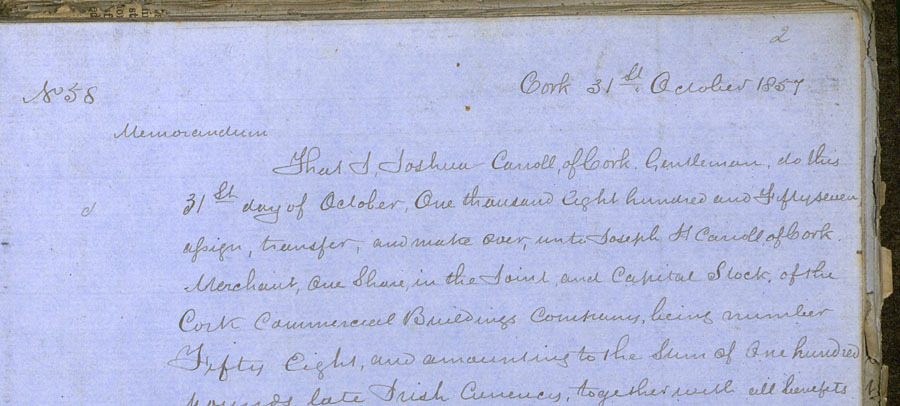
3. Share Transfer Book 1857-1894
4. Index of [Commercial Buildings reading room] Subscribers, Book, 1844-1845.
Also
5. Bound copy of The Munster Bank Limited Liquidation Act 1887.
Cork Commercial Buildings Company (CCBC) was Incorporated by Royal Charter in 1808, to provide an 'Exchange' where merchants could meet to discuss business, arrange contacts on foreign trade and keep abreast of commercial developments in Ireland and abroad. Precursors include: the Tholsel and Exchange, Paradise Place (pre 1710), the Cork Exchange on Castle Street/Main Street (1710); and the Cork Committee of Merchants (Estd. 1769).
The Commercial Rooms/Buildings on the South Mall was designed by Sir Thomas Deane in 1811-1813 and paid for by merchants and others by subscription. (Today it is the Imperial Hotel). It originally contained a newspaper library and reading room and possibly private members rooms, meeting rooms, offices and a café or coffee house.
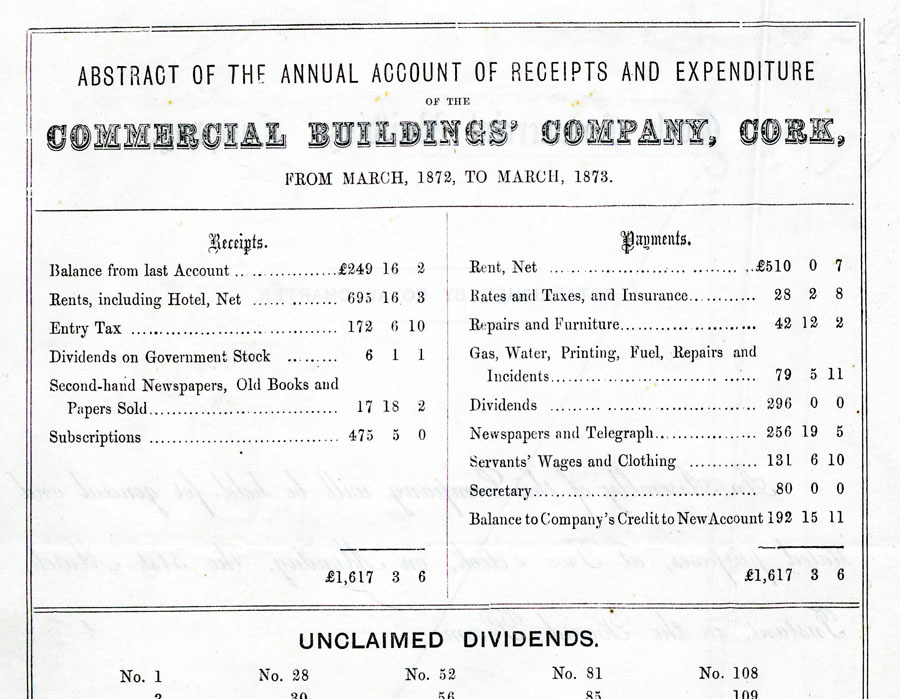
Under the Cocket and Entry Tax or Commercial Buildings Act of 1814, a one shilling Cocket Tax on merchandise entering or leaving Cork was levied. 10% of the tax went to HM Customs with the balance equally divided between the Commercial Buildings Company and Cork Harbour Commissioners (estd. 1814). The tax was therefore used to maintain the commercial buildings and library as well as for harbour improvements. The CCB Company also collected yearly subscriptions from members.
In c1816 the CCBC Committee, or the Committee of Merchants commissioned Thomas Deane to extend the original building along Pembroke Street to serve as a hotel and coach-yard.
In about 1819-1824, the Committee of Directors of the Commercial Buildings Company made a rule bearing on political or religious matters, possibly Catholic Emancipation, which displeased many of the subscribers who seceded and formed a separate Cork Chamber of Commerce, building a reading room and hotel at Patrick Street in 1836 under a Trust Deed lead by James Daly, Thomas Lyons, Charles Sugrue and various shareholders.
2. Letter Book 1840-1874
3. Share Transfer Book 1857-1894
4. Index of [Commercial Buildings reading room] Subscribers, Book, 1844-1845.
Also
5. Bound copy of The Munster Bank Limited Liquidation Act 1887.
Cork Commercial Buildings Company (CCBC) was Incorporated by Royal Charter in 1808, to provide an 'Exchange' where merchants could meet to discuss business, arrange contacts on foreign trade and keep abreast of commercial developments in Ireland and abroad. Precursors include: the Tholsel and Exchange, Paradise Place (pre 1710), the Cork Exchange on Castle Street/Main Street (1710); and the Cork Committee of Merchants (Estd. 1769).
The Commercial Rooms/Buildings on the South Mall was designed by Sir Thomas Deane in 1811-1813 and paid for by merchants and others by subscription. (Today it is the Imperial Hotel). It originally contained a newspaper library and reading room and possibly private members rooms, meeting rooms, offices and a café or coffee house.
Under the Cocket and Entry Tax or Commercial Buildings Act of 1814, a one shilling Cocket Tax on merchandise entering or leaving Cork was levied. 10% of the tax went to HM Customs with the balance equally divided between the Commercial Buildings Company and Cork Harbour Commissioners (estd. 1814). The tax was therefore used to maintain the commercial buildings and library as well as for harbour improvements. The CCB Company also collected yearly subscriptions from members.
In c1816 the CCBC Committee, or the Committee of Merchants commissioned Thomas Deane to extend the original building along Pembroke Street to serve as a hotel and coach-yard.
In about 1819-1824, the Committee of Directors of the Commercial Buildings Company made a rule bearing on political or religious matters, possibly Catholic Emancipation, which displeased many of the subscribers who seceded and formed a separate Cork Chamber of Commerce, building a reading room and hotel at Patrick Street in 1836 under a Trust Deed lead by James Daly, Thomas Lyons, Charles Sugrue and various shareholders.
Extent5 vols. (1 box)
LanguageEnglish
Persons keywordCork Commercial Buildings Company
AccessHard copies: Accessible to Readers by appointment. Access restrictions apply to some collections. Digital object/copy: see Download Media and/or Digital Reference
RightsLicensing information available on request by email to archivist@corkcity.ie Copyright Cork City and County Archives, Cork City Council, unless otherwise indicated. All Rights Reserved.
Levelfonds
Object categoryBusiness Records



Download media