

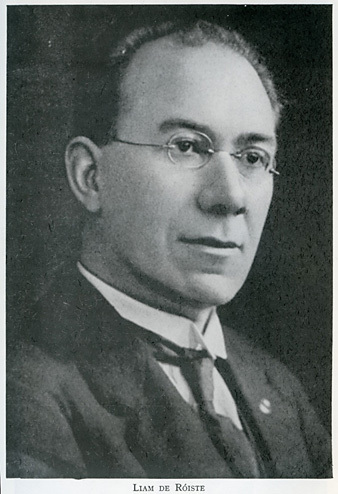
Liam de Róiste Papers
TitleLiam de Róiste Papers
ReferenceIE 627/U271
Date
(1893) 1900-1959 (1969)
Production date 1900 - 1959
Scope and ContentPersonal archive of politician, Irish language activist, and writer, Liam de Róiste T.D. Includes personal records and correspondence, and records and ephemera of various organisations in which de Róiste officiated or was a member.
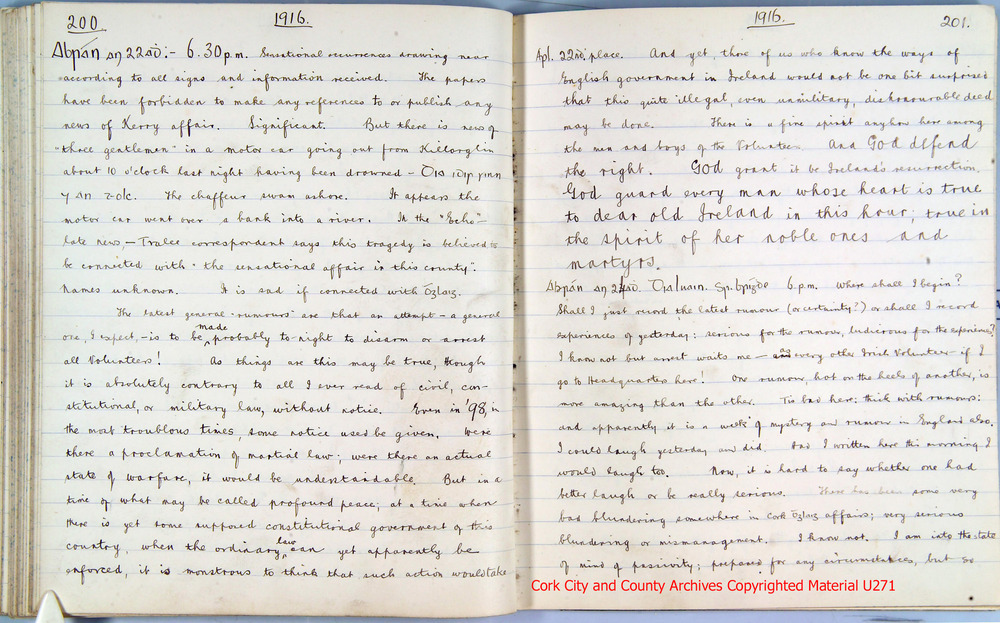
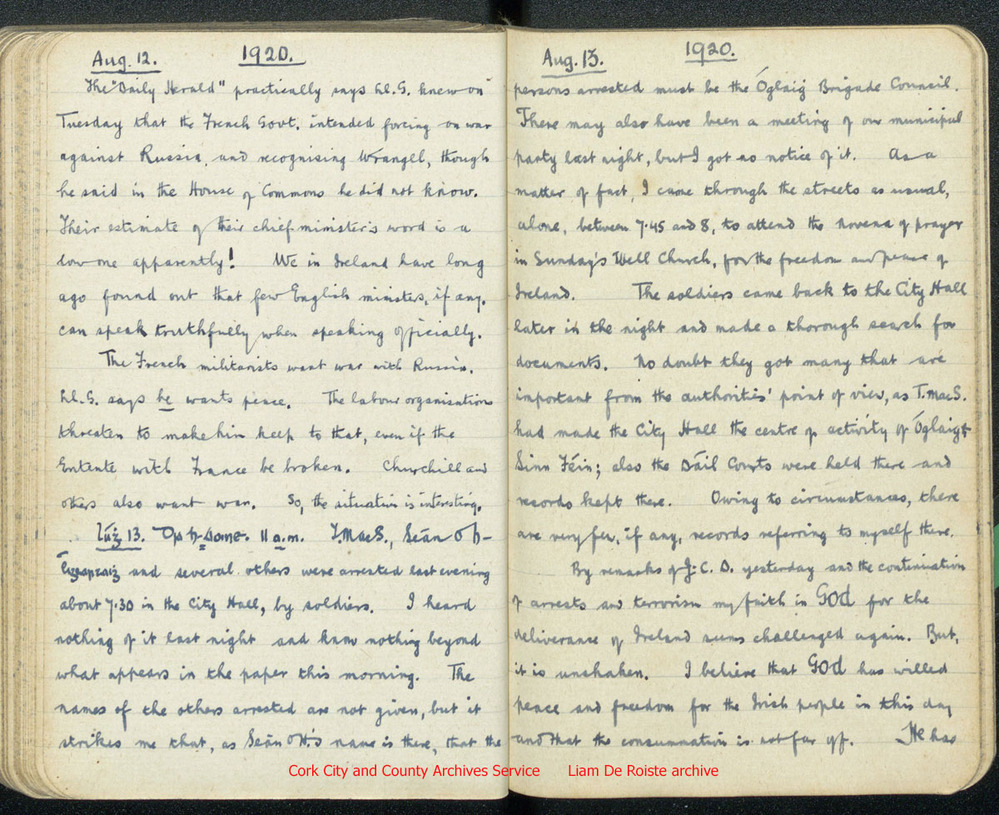
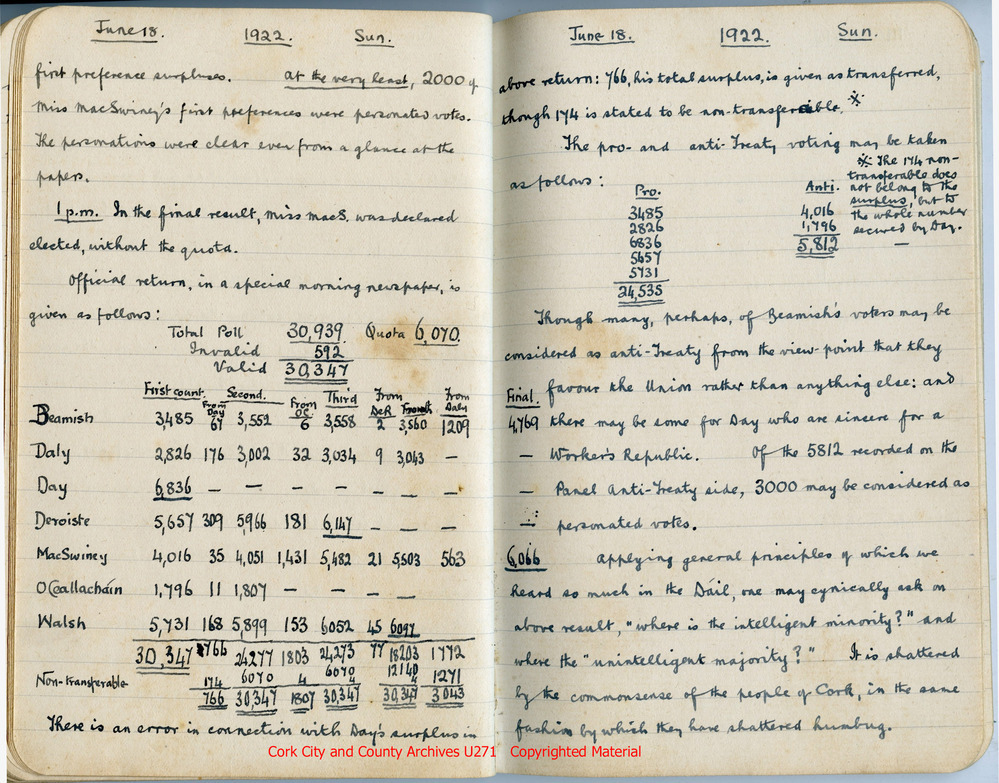
Section A: Diaries/Journals and Memoirs 1902-1947 contain extensive commentary on current affairs, responses to events, and personal reflections, on numerous topics. It will be noted that no diaries are present from Jun 1910 to Nov 1914, Jan to Aug 1917 or Jan 1930 to May 1945. (Other topic-specific memoirs are also present in other sections of the collection such as U271/F/9).
Section B: Cork Celtic Literary Society 1900-c1910 includes a large series of its manuscript journal ‘Éire Óg’ revealing the thinking of De Rósite and other founding members of the radical separatist cultural and political movement then developing. Much criticism is made in the journal of British rule in Ireland and its supporters. The Cork Exhibition 1905, is, for example described as ‘anti-Irish’ (B/4/19). De Róiste’s friendship and alliance with Terence MacSwiney is revealed in a 1907 letter, ‘We have fought many a good fight side by side, if we have not always seen eye to eye. And I hope we will yet share in many a victory together’ (U271/B/6/7). The CCLS appears to have become/been a branch of the national organisation Conradh na Gaeilge/the Gaelic League.
Section C: Gaelic League 1893-1918. De Róiste was at times Chairman and Secretary of the Cork branch of the national Gaelic League which appears to have succeeded the Cork Celtic Literary Society. The material in this section mainly regards the promotion and teaching of the Irish language and Irish culture. Present, for example, is a list of National Schools in Cork teaching Irish in c1915 (U271/C/5/9) and correspondence with Cork Corporation officials about street naming in Irish (U271/C/1/C).
Section D: Sinn Féin 1906-1918. This section documents Sinn Féin from its earlier years up to its major political victories in 1917 and in the 1918 General Election. A Dec 1917 letter from Bishop Daniel Coholan refers to possible violence on the streets with the visit of Éamon de Valera. (U271/D/3/6a/4). Also present is a series of 1918 Election leaflets for De Róiste and JJ. Walsh (U271/D/8/D) and extensive ephemera concerning the East Clare by-election in 1917 (U271/D/4). Some correspondence is also present including a letter to de Róiste from Daniel Corkery in Aug 1918 with his opinion on the choice of Sinn Féin candidates for Cork City, '...we should strive to have in that party such a variety of mind as will...correspond with the variety of mind in a healthy nation'. Notes Ireland has a 'general dearth' of intellectuals, and Sinn Féin suffers more than any other party from this. It must appoint leaders 'the world will accept', to prevent the party from 'appearing in the eyes of the world as a collection of village notabilities'. (U271/D/8/E/002)
Section E: Cork Industrial Development Association 1903-1922; De Róiste together with Diarmaid L. Fawsitt was the driving force behind the Cork IDA and at its establishment in 1903. Its stated purpose was to forward the interests of Irish manufactures and products, ’primarily intended to check the awful exodus of our people' through emigration (U271/E/1/1).
Section F: Coláiste na Mumhan, Ballingeary 1904-1955. De Róiste was a key organiser and Secretary of the College and the section contains both administrative records and extensive memoirs in both Irish and English (U271/F/9). In the memoirs, he recalls personal reminiscences of local characters and visitors, including that of Terence MacSwiney staying at 'The Lodge' of the Cronin’s and a walk with MacSwiney in the hills to Tuiríndubh, 'Traolach and myself had been friends and associates since boyhood. The stress and the strain, the glory, and the tragedy of events to come were hidden in the womb of the future. The memory of that quiet evening in the hills may have come to mind when I knelt by his deathbed in Brixton Prison...'. (U271/F/9/1)
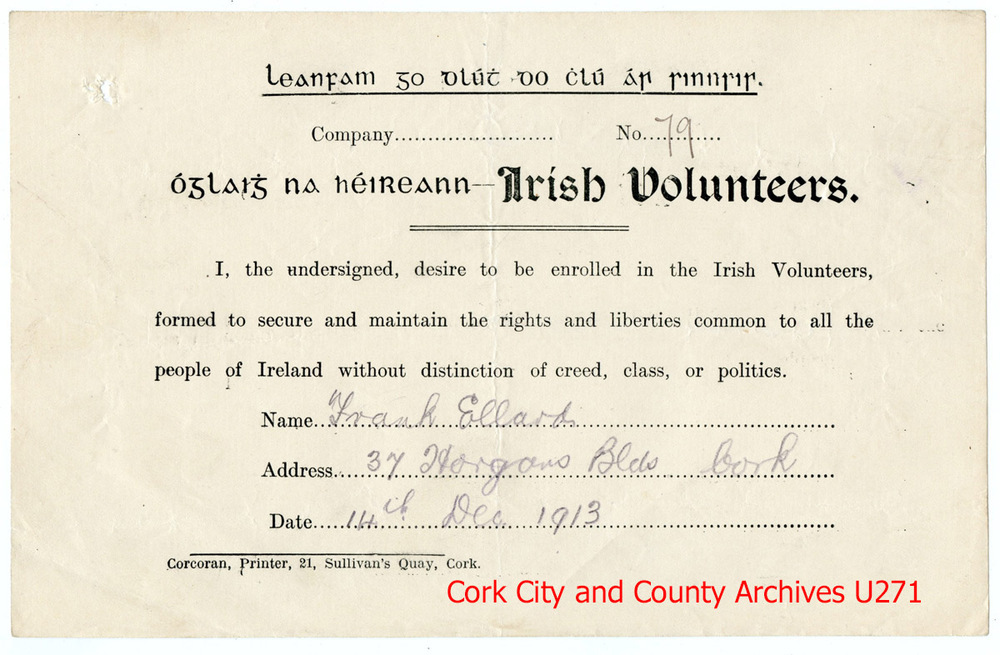
Section G: Irish Volunteers Cork Corps 1913-21. De Róiste as a founder member and Secretary of the Cork Corps kept records from the early years of the Volunteers in Cork including a set of c1700 membership forms 1913-1914 (U271/G/003). Themes documented include the split in the Volunteers (U271/G/006/2), and the aftermath of the Easter Rising (U271/G/9/B). De Róiste remained a Dáil Éireann politician and was not a soldier during the War of Independence (his diaries and memoirs in Section A document that period in detail). However, present in Section G are a number of letters from IRA prisoners during the War of Independence, including Tadgh Barry (U271/010/D), and Sarah Duggan of Cumann na mBan (U271/G/010/E).
Section H: Dáil Éireann 1919-1923. This is a substantial section which documents the First, Second and Third Dáils and de Róiste’s time as a T.D. The First Dáil sub section, Jan 1919-May 1921, documents its initial organisation and administration including a set of reports from various committees/departments to the Dáil on various topics including local government, trade and industry, propaganda, courts, fisheries, foreign affairs, finances, agriculture etc. (U271/H/1/A/002). A large file is also present concerning the administration of the first Dáil Loan 1919-1929 in Cork, which de Róiste may have been administering or overseeing, including a register of subscribers for Cork City, (U271/H/1/A/006). All of de Róiste’s correspondence as a Sinn Féin TD for the period is included, mainly incoming material (U271/H/1/B); including significant files from JJ Walsh, Michael Collins, the Sinn Féin party, and one of Lord Mayor Tomás MacCurtain’s final letters dated 19 March 1920, hours before his death at home at the hands of crown forces (U271/H/1/B/2/C). The sub-section on the Second Dáil covers the period of transition from armed revolution to Truce, to the Anglo-Irish Treaty debate (U271/H/2/012) and Dáil ratification. De Róiste chaired some of the fractious Treaty debates in Dáil Éireann, having been, as stated in his later correspondence, the first TD to speak publicly in favour of the Treaty (See U271/J/001/004). The Third Dáil sub section covers the period from, and including, the June 1922 election, the Civil War, the establishment and first months of the Irish Free State. De Róiste actively campaigned for the acceptance of the Treaty but despaired at the bloodshed and destruction of the Civil War, “…I entered public life most unwillingly in 1918, feeling it was a duty placed upon me. I remained in public life since, during the period of English armed aggression, for the same reason. With fratricidal strife and a blood feud between former comrades, I can have nothing to do. I can give no approval to it on one side or the other. My duty in public life is therefore, ended and I have already decided to retire as a representative…” (U271/H/3/A/6). He took the stance of attempting to reconcile the two factions (U271/H/3/E) which would, as he wished, end his career in national politics. It is notable that the collection contains both pro-Treaty and anti-Treaty correspondence and ephemera (U271/H/3/G and H). De Róiste appears to have set out a claim to the Provisional Government for over £3,000,000 in reparations from the British for the destruction in Cork City in the period Jan 1919-Dec 1921 (U271/H/3/F/1). De Róiste also appears to have been involved in the drafting of the Irish Free State Constitution (U271/H/3/K)
Section I: Local Government, 1915-1950. A limited amount of material mainly relating to Cork Corporation. This includes material relating to the 1920 Local Election where De Róiste was elected as a Councillor/Alderman of the City for the first time, such as registers of electors for 2 polling districts, compiled under the Representation of the People Act 1918, which incorporated women voters for the first time. (U271/I/A/2 and 3) Despite de Róiste being appointed a Cork Harbour Commissioner, very little material is present in the collection relating to this body (U271/I/4).
Section J: Later Correspondence 1924-1954. This section comprises mainly political and non-private correspondence dating from after the end of De Róiste’s tenure as a T.D. but excluding his involvement with Cumann na Gaedheal (see section K). De Róiste did not stand in the August 1923 general election. This section includes a series of letters 1925 – 1948 from former colleague and friend, JJ Walsh, who remained a TD, and was appointed as the Minister of Posts and Telegraphs in the Irish Free State. (U271/J/001) De Róiste appears to have maintained some contact with governmental figures for example in relation to trade policy (U271/J/004/6) and was invited yearly by President Cosgrave to the Griffith-Collins anniversary memorials (U271/J/003). It is notable that little correspondence is present for the 1930s and 1940s, with nothing ostensibly relating to De Róiste’s support for radical nationalism and the political party Ailtirí na hAiséirghe. It will be noted that JJ Walsh and Ernest Blythe and a number of other politicians and Irish language activists, including members of some republican Sinn Féin and IRA factions, were also supporters. (See also: Section L documenting De Róiste’s involvement with the Irish Christian Front).
Section K: Cumann na nGaedheal 1925-1929. This section mainly documents De Róiste’s unsuccessful campaigns for the Seanad in 1925, and the Dáil in 1927, as a Cumann na nGaedheal party candidate. An election leaflet from 1927 encouraged the public to ‘VOTE FOR the Party which saved Ireland from Anarchy five years ago....done solid work for Ireland...guarantee Peace, Prosperity, and Good Government...’ . The leaflet details of the governing party’s achievements while in government and includes photographs of the candidates in Cork, de Róiste, Barry M. Egan, Michael Egan, and JJ Walsh (U271/K/2/D/4). Also includes organisational material relating to the party (U271/K/2/A and B).
Section L: Irish Christian Front 1936-1937. This section of c30 items provides a valuable insight into the formation of the ICF, and de Róiste’s contribution to it, such as, correspondence with ICF and church officials and other interested individuals (U271/L/1), drafts of his suggestions for the aims and organisation of the ICF (U271/L/2) and the text of his speech at a public rally held in Cork in Sep 1936 (U271/L/3). De Róiste and others were not in favour with the ICF becoming a political party and regarded it as a public crusade of support against the ‘Red terror’ and ‘Atheistic’ or ‘anti-Christian’ forces (U271/L/3/3). (Additional information about de Róiste’s support for Catholic activism and his political and social thinking in the 1930s and 1940s may be found in some of the essays and articles in Section O)
Section M: Muintir na Tíre 1937-1953. De Róiste was president of the Cork guild of Muintir na Tíre in c1939. This section includes texts of lectures by de Róiste (U271/M/3) and extensive correspondence with Alfred O’Reilly and other regarding aims, principles, and organisation (U271/M/4) and also a set of leaflets and publications (U271/M/5 and 6)
Section N: Bureau of Military History 1947-1957. De Róiste engaged extensively with the Bureau and provided a number of accounts on the Irish Volunteers Cork corps (U271/N/3 and 3a). Also found are a set of booklets issued by the Bureau (U271/N/1) and correspondence with Florence O’Donoghue and other officials of the Bureau, and others such as long-time friend and associate Diarmaid L. Fawsitt. (U271/N/2).
Section O: Literary Papers, Essays, Research Notes and Lecture/Speech Texts 1898-1945. The literary material includes scripts by de Róiste, mainly from the early 1900s, of plays such as the ‘Wooing of Time’, ‘The Drunkard’, ‘Percy Connors’, ‘The Road to Hell’ and others (U271/O/1/A). It also includes a set of short stories from the same period and up to 1922 such as ‘Ceann Dubh Dílis’/ Dear Dark Head, 'A Study of a young Irishman's mind which may illuminate Irish History for the twenty years prior to 1916'. (U271/O/1/B) The section also contains a small amount of poetry mainly by De Róiste including a poem on the death of Michael Collins signed ‘Corkagian’: "Longtime the British ban-dogs tried to hunt their quarry down / 'Mick' little cared, the while he dared, the forces of the Crown...The darling of our race was he, our people's hope and pride/ Old Erin's name was steeped in shame, when Micheal Collins died....” (U271/O/1/C). The set of essays/articles by de Róiste is extensive, dating from c1900 to 1951, on a variety of topics, such as ‘Socialism’ (U271/O/2/A/011) and ‘A Catholic Social Policy for Ireland’ (U271/O/2/B/001). An extensive essay/article from February 1933, ‘Seanachus na h-Aimsire-Seo: Go Mór Mór i nÉirinn. (Discussion of Present Times: What is prevalent in Ireland),’ is somewhat revealing of de Róiste’s political thinking during the period following the election of Fianna Fáíl, and it also contains a critique of Ireland’s society, economy, politics and history. He notes, for example, the 'restraining influence' of religion in Ireland and the 'a curious phenomena of mind' whereby, after a lapse of time, it is possible to get nearer the truth of an affair, than was possible at the time. (U271/O/2/C/005). The essays/articles from 1930s and 1940s are particularly significant as little other material created by de Róiste is found for this period in the collection. Some of the earlier essays/articles may have been written for the journal of the Cork Celtic Literary Society (U271/B/3 and 4), and others may have been drafted for newspaper articles or other publications. The Notes and Research sub section (U271/O/3) and Lecture/Speech texts (U271/O/4) contain a variety of material relating to de Róiste's interests including religion, the economy, the Irish language, philosophy, local and national historical events and periods, and his thoughts on diverse topics.
Section P: Businessman 1920-1955. This section contains a limited amount of material relating to De Róiste’s career as a businessman principally with the Irish International Trading Corporation. (See also: collection B639)
Section Q: Other Organisations 1904-1940. A limited amount of material relating to various organisations with which de Róiste was involved or interacted. Of particular note is the O’Donovan Rossa Reception Committee 1904 minute book (U271/Q/001); a set of leaflets from the Department of Recruiting for Ireland for the First World War period 1914-1918, attempting to encourage Irishmen to enlist in the British forces (U271/Q/004); leaflets from the Women’s Party in London (U271/Q/005); also some items from the Friends of Irish Freedom 1919-1928, of which Diarmuid Lynch, a lifelong family friend and associate of de Róiste, was national secretary (U271/Q/007). There is also some material relating to the Irish White Cross 1921-1924 which was set up to provide relief to those effected by the wars in Ireland (U271/Q/008).
Section R: Personal Life 1905-1940. A limited amount of material relating to de Róiste’s personal private life including his marriage to Nora, his academic life, and miscellaneous correspondence.
Section S: Printed Publications and Ephemera 1900-1958. As well as small collections of books and magazines and newsclippings, also includes additional nationalist and revolutionary period ephemera such as a booklet c1915 prepared by de Róiste, ‘Voices of the Past’, with ‘Extracts from the Writings and Speeches of Irish Leaders of Opinion, Patriots, Poets and Orators for the Past Four Hundred Years’ (U271/S/C/1/1).
Section T: Photographs 1902-1949. A small set of photographs, such as, a group photograph from 1902 of members of the Cork Celtic Literary Society/Cork Young Ireland Society, in Ballyvourney, including Terence MacSwiney (U271/T/001); and a photograph of Fr. James O’Callaghan CC who was shot dead by crown forces at de Róiste's home on 15 May 1921. (U271/T/004)
The collection is particularly of interest to the study of the Irish Revolutionary Period 1912-1923 and resurgent Irish cultural and political Nationalism and Republicanism of the pre- and post- revolutionary period. It also documents the early Dáíl Éireann, and the origins and early years of the Irish Free State. It provides an extensive archive documenting the transition from cultural revival to armed revolution to state formation in modern Ireland.
The collection documents several themes including advocacy for national independence, critique of British rule, evolution from cultural to political revolution, promotion of the Irish language and cultural revival, Gaelic League activity, Irish-language education, literary productions, political activism and state-building, Sinn Féin organisation, Dáil Éireann establishment and administration, Treaty and Civil War divisions, military and revolutionary activity in the form of the Irish Volunteers, the Easter Rising, War of Independence and First World War; economic nationalism, industrial development, trade and employment initiatives; social and religious movements, Catholic activism and rural organisation, personal reflection and memory, diaries and memoirs, and retrospective analysis.
Section A: Diaries/Journals and Memoirs 1902-1947 contain extensive commentary on current affairs, responses to events, and personal reflections, on numerous topics. It will be noted that no diaries are present from Jun 1910 to Nov 1914, Jan to Aug 1917 or Jan 1930 to May 1945. (Other topic-specific memoirs are also present in other sections of the collection such as U271/F/9).
Section B: Cork Celtic Literary Society 1900-c1910 includes a large series of its manuscript journal ‘Éire Óg’ revealing the thinking of De Rósite and other founding members of the radical separatist cultural and political movement then developing. Much criticism is made in the journal of British rule in Ireland and its supporters. The Cork Exhibition 1905, is, for example described as ‘anti-Irish’ (B/4/19). De Róiste’s friendship and alliance with Terence MacSwiney is revealed in a 1907 letter, ‘We have fought many a good fight side by side, if we have not always seen eye to eye. And I hope we will yet share in many a victory together’ (U271/B/6/7). The CCLS appears to have become/been a branch of the national organisation Conradh na Gaeilge/the Gaelic League.
Section C: Gaelic League 1893-1918. De Róiste was at times Chairman and Secretary of the Cork branch of the national Gaelic League which appears to have succeeded the Cork Celtic Literary Society. The material in this section mainly regards the promotion and teaching of the Irish language and Irish culture. Present, for example, is a list of National Schools in Cork teaching Irish in c1915 (U271/C/5/9) and correspondence with Cork Corporation officials about street naming in Irish (U271/C/1/C).
Section D: Sinn Féin 1906-1918. This section documents Sinn Féin from its earlier years up to its major political victories in 1917 and in the 1918 General Election. A Dec 1917 letter from Bishop Daniel Coholan refers to possible violence on the streets with the visit of Éamon de Valera. (U271/D/3/6a/4). Also present is a series of 1918 Election leaflets for De Róiste and JJ. Walsh (U271/D/8/D) and extensive ephemera concerning the East Clare by-election in 1917 (U271/D/4). Some correspondence is also present including a letter to de Róiste from Daniel Corkery in Aug 1918 with his opinion on the choice of Sinn Féin candidates for Cork City, '...we should strive to have in that party such a variety of mind as will...correspond with the variety of mind in a healthy nation'. Notes Ireland has a 'general dearth' of intellectuals, and Sinn Féin suffers more than any other party from this. It must appoint leaders 'the world will accept', to prevent the party from 'appearing in the eyes of the world as a collection of village notabilities'. (U271/D/8/E/002)
Section E: Cork Industrial Development Association 1903-1922; De Róiste together with Diarmaid L. Fawsitt was the driving force behind the Cork IDA and at its establishment in 1903. Its stated purpose was to forward the interests of Irish manufactures and products, ’primarily intended to check the awful exodus of our people' through emigration (U271/E/1/1).
Section F: Coláiste na Mumhan, Ballingeary 1904-1955. De Róiste was a key organiser and Secretary of the College and the section contains both administrative records and extensive memoirs in both Irish and English (U271/F/9). In the memoirs, he recalls personal reminiscences of local characters and visitors, including that of Terence MacSwiney staying at 'The Lodge' of the Cronin’s and a walk with MacSwiney in the hills to Tuiríndubh, 'Traolach and myself had been friends and associates since boyhood. The stress and the strain, the glory, and the tragedy of events to come were hidden in the womb of the future. The memory of that quiet evening in the hills may have come to mind when I knelt by his deathbed in Brixton Prison...'. (U271/F/9/1)
Section G: Irish Volunteers Cork Corps 1913-21. De Róiste as a founder member and Secretary of the Cork Corps kept records from the early years of the Volunteers in Cork including a set of c1700 membership forms 1913-1914 (U271/G/003). Themes documented include the split in the Volunteers (U271/G/006/2), and the aftermath of the Easter Rising (U271/G/9/B). De Róiste remained a Dáil Éireann politician and was not a soldier during the War of Independence (his diaries and memoirs in Section A document that period in detail). However, present in Section G are a number of letters from IRA prisoners during the War of Independence, including Tadgh Barry (U271/010/D), and Sarah Duggan of Cumann na mBan (U271/G/010/E).
Section H: Dáil Éireann 1919-1923. This is a substantial section which documents the First, Second and Third Dáils and de Róiste’s time as a T.D. The First Dáil sub section, Jan 1919-May 1921, documents its initial organisation and administration including a set of reports from various committees/departments to the Dáil on various topics including local government, trade and industry, propaganda, courts, fisheries, foreign affairs, finances, agriculture etc. (U271/H/1/A/002). A large file is also present concerning the administration of the first Dáil Loan 1919-1929 in Cork, which de Róiste may have been administering or overseeing, including a register of subscribers for Cork City, (U271/H/1/A/006). All of de Róiste’s correspondence as a Sinn Féin TD for the period is included, mainly incoming material (U271/H/1/B); including significant files from JJ Walsh, Michael Collins, the Sinn Féin party, and one of Lord Mayor Tomás MacCurtain’s final letters dated 19 March 1920, hours before his death at home at the hands of crown forces (U271/H/1/B/2/C). The sub-section on the Second Dáil covers the period of transition from armed revolution to Truce, to the Anglo-Irish Treaty debate (U271/H/2/012) and Dáil ratification. De Róiste chaired some of the fractious Treaty debates in Dáil Éireann, having been, as stated in his later correspondence, the first TD to speak publicly in favour of the Treaty (See U271/J/001/004). The Third Dáil sub section covers the period from, and including, the June 1922 election, the Civil War, the establishment and first months of the Irish Free State. De Róiste actively campaigned for the acceptance of the Treaty but despaired at the bloodshed and destruction of the Civil War, “…I entered public life most unwillingly in 1918, feeling it was a duty placed upon me. I remained in public life since, during the period of English armed aggression, for the same reason. With fratricidal strife and a blood feud between former comrades, I can have nothing to do. I can give no approval to it on one side or the other. My duty in public life is therefore, ended and I have already decided to retire as a representative…” (U271/H/3/A/6). He took the stance of attempting to reconcile the two factions (U271/H/3/E) which would, as he wished, end his career in national politics. It is notable that the collection contains both pro-Treaty and anti-Treaty correspondence and ephemera (U271/H/3/G and H). De Róiste appears to have set out a claim to the Provisional Government for over £3,000,000 in reparations from the British for the destruction in Cork City in the period Jan 1919-Dec 1921 (U271/H/3/F/1). De Róiste also appears to have been involved in the drafting of the Irish Free State Constitution (U271/H/3/K)
Section I: Local Government, 1915-1950. A limited amount of material mainly relating to Cork Corporation. This includes material relating to the 1920 Local Election where De Róiste was elected as a Councillor/Alderman of the City for the first time, such as registers of electors for 2 polling districts, compiled under the Representation of the People Act 1918, which incorporated women voters for the first time. (U271/I/A/2 and 3) Despite de Róiste being appointed a Cork Harbour Commissioner, very little material is present in the collection relating to this body (U271/I/4).
Section J: Later Correspondence 1924-1954. This section comprises mainly political and non-private correspondence dating from after the end of De Róiste’s tenure as a T.D. but excluding his involvement with Cumann na Gaedheal (see section K). De Róiste did not stand in the August 1923 general election. This section includes a series of letters 1925 – 1948 from former colleague and friend, JJ Walsh, who remained a TD, and was appointed as the Minister of Posts and Telegraphs in the Irish Free State. (U271/J/001) De Róiste appears to have maintained some contact with governmental figures for example in relation to trade policy (U271/J/004/6) and was invited yearly by President Cosgrave to the Griffith-Collins anniversary memorials (U271/J/003). It is notable that little correspondence is present for the 1930s and 1940s, with nothing ostensibly relating to De Róiste’s support for radical nationalism and the political party Ailtirí na hAiséirghe. It will be noted that JJ Walsh and Ernest Blythe and a number of other politicians and Irish language activists, including members of some republican Sinn Féin and IRA factions, were also supporters. (See also: Section L documenting De Róiste’s involvement with the Irish Christian Front).
Section K: Cumann na nGaedheal 1925-1929. This section mainly documents De Róiste’s unsuccessful campaigns for the Seanad in 1925, and the Dáil in 1927, as a Cumann na nGaedheal party candidate. An election leaflet from 1927 encouraged the public to ‘VOTE FOR the Party which saved Ireland from Anarchy five years ago....done solid work for Ireland...guarantee Peace, Prosperity, and Good Government...’ . The leaflet details of the governing party’s achievements while in government and includes photographs of the candidates in Cork, de Róiste, Barry M. Egan, Michael Egan, and JJ Walsh (U271/K/2/D/4). Also includes organisational material relating to the party (U271/K/2/A and B).
Section L: Irish Christian Front 1936-1937. This section of c30 items provides a valuable insight into the formation of the ICF, and de Róiste’s contribution to it, such as, correspondence with ICF and church officials and other interested individuals (U271/L/1), drafts of his suggestions for the aims and organisation of the ICF (U271/L/2) and the text of his speech at a public rally held in Cork in Sep 1936 (U271/L/3). De Róiste and others were not in favour with the ICF becoming a political party and regarded it as a public crusade of support against the ‘Red terror’ and ‘Atheistic’ or ‘anti-Christian’ forces (U271/L/3/3). (Additional information about de Róiste’s support for Catholic activism and his political and social thinking in the 1930s and 1940s may be found in some of the essays and articles in Section O)
Section M: Muintir na Tíre 1937-1953. De Róiste was president of the Cork guild of Muintir na Tíre in c1939. This section includes texts of lectures by de Róiste (U271/M/3) and extensive correspondence with Alfred O’Reilly and other regarding aims, principles, and organisation (U271/M/4) and also a set of leaflets and publications (U271/M/5 and 6)
Section N: Bureau of Military History 1947-1957. De Róiste engaged extensively with the Bureau and provided a number of accounts on the Irish Volunteers Cork corps (U271/N/3 and 3a). Also found are a set of booklets issued by the Bureau (U271/N/1) and correspondence with Florence O’Donoghue and other officials of the Bureau, and others such as long-time friend and associate Diarmaid L. Fawsitt. (U271/N/2).
Section O: Literary Papers, Essays, Research Notes and Lecture/Speech Texts 1898-1945. The literary material includes scripts by de Róiste, mainly from the early 1900s, of plays such as the ‘Wooing of Time’, ‘The Drunkard’, ‘Percy Connors’, ‘The Road to Hell’ and others (U271/O/1/A). It also includes a set of short stories from the same period and up to 1922 such as ‘Ceann Dubh Dílis’/ Dear Dark Head, 'A Study of a young Irishman's mind which may illuminate Irish History for the twenty years prior to 1916'. (U271/O/1/B) The section also contains a small amount of poetry mainly by De Róiste including a poem on the death of Michael Collins signed ‘Corkagian’: "Longtime the British ban-dogs tried to hunt their quarry down / 'Mick' little cared, the while he dared, the forces of the Crown...The darling of our race was he, our people's hope and pride/ Old Erin's name was steeped in shame, when Micheal Collins died....” (U271/O/1/C). The set of essays/articles by de Róiste is extensive, dating from c1900 to 1951, on a variety of topics, such as ‘Socialism’ (U271/O/2/A/011) and ‘A Catholic Social Policy for Ireland’ (U271/O/2/B/001). An extensive essay/article from February 1933, ‘Seanachus na h-Aimsire-Seo: Go Mór Mór i nÉirinn. (Discussion of Present Times: What is prevalent in Ireland),’ is somewhat revealing of de Róiste’s political thinking during the period following the election of Fianna Fáíl, and it also contains a critique of Ireland’s society, economy, politics and history. He notes, for example, the 'restraining influence' of religion in Ireland and the 'a curious phenomena of mind' whereby, after a lapse of time, it is possible to get nearer the truth of an affair, than was possible at the time. (U271/O/2/C/005). The essays/articles from 1930s and 1940s are particularly significant as little other material created by de Róiste is found for this period in the collection. Some of the earlier essays/articles may have been written for the journal of the Cork Celtic Literary Society (U271/B/3 and 4), and others may have been drafted for newspaper articles or other publications. The Notes and Research sub section (U271/O/3) and Lecture/Speech texts (U271/O/4) contain a variety of material relating to de Róiste's interests including religion, the economy, the Irish language, philosophy, local and national historical events and periods, and his thoughts on diverse topics.
Section P: Businessman 1920-1955. This section contains a limited amount of material relating to De Róiste’s career as a businessman principally with the Irish International Trading Corporation. (See also: collection B639)
Section Q: Other Organisations 1904-1940. A limited amount of material relating to various organisations with which de Róiste was involved or interacted. Of particular note is the O’Donovan Rossa Reception Committee 1904 minute book (U271/Q/001); a set of leaflets from the Department of Recruiting for Ireland for the First World War period 1914-1918, attempting to encourage Irishmen to enlist in the British forces (U271/Q/004); leaflets from the Women’s Party in London (U271/Q/005); also some items from the Friends of Irish Freedom 1919-1928, of which Diarmuid Lynch, a lifelong family friend and associate of de Róiste, was national secretary (U271/Q/007). There is also some material relating to the Irish White Cross 1921-1924 which was set up to provide relief to those effected by the wars in Ireland (U271/Q/008).
Section R: Personal Life 1905-1940. A limited amount of material relating to de Róiste’s personal private life including his marriage to Nora, his academic life, and miscellaneous correspondence.
Section S: Printed Publications and Ephemera 1900-1958. As well as small collections of books and magazines and newsclippings, also includes additional nationalist and revolutionary period ephemera such as a booklet c1915 prepared by de Róiste, ‘Voices of the Past’, with ‘Extracts from the Writings and Speeches of Irish Leaders of Opinion, Patriots, Poets and Orators for the Past Four Hundred Years’ (U271/S/C/1/1).
Section T: Photographs 1902-1949. A small set of photographs, such as, a group photograph from 1902 of members of the Cork Celtic Literary Society/Cork Young Ireland Society, in Ballyvourney, including Terence MacSwiney (U271/T/001); and a photograph of Fr. James O’Callaghan CC who was shot dead by crown forces at de Róiste's home on 15 May 1921. (U271/T/004)
The collection is particularly of interest to the study of the Irish Revolutionary Period 1912-1923 and resurgent Irish cultural and political Nationalism and Republicanism of the pre- and post- revolutionary period. It also documents the early Dáíl Éireann, and the origins and early years of the Irish Free State. It provides an extensive archive documenting the transition from cultural revival to armed revolution to state formation in modern Ireland.
The collection documents several themes including advocacy for national independence, critique of British rule, evolution from cultural to political revolution, promotion of the Irish language and cultural revival, Gaelic League activity, Irish-language education, literary productions, political activism and state-building, Sinn Féin organisation, Dáil Éireann establishment and administration, Treaty and Civil War divisions, military and revolutionary activity in the form of the Irish Volunteers, the Easter Rising, War of Independence and First World War; economic nationalism, industrial development, trade and employment initiatives; social and religious movements, Catholic activism and rural organisation, personal reflection and memory, diaries and memoirs, and retrospective analysis.
Extent18 boxes
Physical descriptionMainly in hard copy only. Diaries 1914-1923 and Irish Volunteer Cork Corps membership forms c1913-1914 available online.
LanguageEnglish and Irish
Persons keywordDe Roiste, Liam | 1882-1959 | T.D., diarist, Gaelic scholar, Sinn Féin, Dáil Éireann, Cork Civic Party, Cork Corporation, Irish Volunteers
SubjectIrish Nationalism, Military organisations, Irish Republicanism, Politics, War of Independence (Ireland)
AccessHard copies: Accessible to Readers by appointment. Access restrictions apply to some collections. Digital object/copy: see Download Media and/or Digital Reference
RightsLicensing information available on request by email to archivist@corkcity.ie Copyright Cork City and County Archives, Cork City Council, unless otherwise indicated. All Rights Reserved.
Levelfonds
RepositoryCork City and County Archives
Digital reference
Object categoryPersonal Papers
Download media