

TJ Clanchy, Cork Butter Merchant
TitleTJ Clanchy, Cork Butter Merchant
ReferenceIE 627/PR11
Date
1860-1946 (1991)
Production date 1860 - 1991
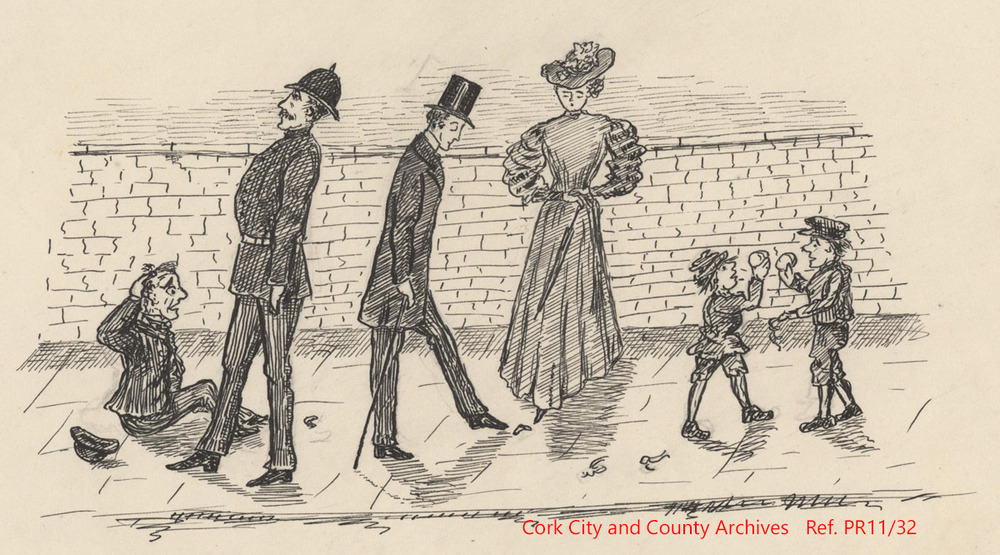
Scope and ContentPapers relating to T. J. Clanchy, Cork butter merchant (1835-1897). The collection is of interest in documenting both the family and the public lives of a prominent Cork figure in the later 19th century. The family papers, including legal documents, correspondence, photographs, and memorabilia, reveal the formal and informal ties connecting Clanchy’s large family. His daughter Elizabeth kept most of the collection together and passed it on to her daughter, Sheila Murphy. There are photographs of Clanchy’s son, Hugh, who served in the First World War, and of his daughter Mary, who became a nun in the Society of the Sacred Heart. Mary provided Sheila Murphy, her step-niece, with accounts of growing up in the Clanchy home at ‘Sunville’ (PR11/24). Clanchy himself seems to have written some light verse for publication, but most of his efforts, along with his own illustrations, were for the amusement of his children ( PR11/32). These stand in contrast with more serious work, such as his book, Ireland in the Twentieth Century .
While the collection contains some record of Clanchy’s business, as well as his public and charitable work, it is the small volume of political correspondence, relating to the Irish Parliamentary Party in the 1890s, which is of most interest. The Irish Party in these years was riven by dissension. The split into Parnellite and Anti-Parnellite factions in 1891-92 was traumatic, creating a long-lasting division and ongoing bitterness. While the Anti-Parnellite group became the dominant one and retained the name of the Irish Party, factions continued to jostle for control of the party and its organisational machinery. Party debts and funds, including the ‘Paris Fund’ set up to assist evicted tenants, also became sources of dispute, as a letter to Clanchy from WJ Lane, the prominent Cork merchant, reveals (PR11/43).
The letters in the present collection shed light on a difficult Party Committee election in 1895 (PR11/45-47). They also include correspondence between Clanchy and Justin McCarthy, chairman of the Irish Party (PR11/42, 43). While he declined the invitation to run for parliament himself, Clanchy was clearly a loyal Party man, providing advice and financial assistance. Also present is a letter from TA O’Callaghan, Catholic bishop of Cork, regarding an election, hinting at the close involvement of the Catholic hierarchy in nationalist politics (PR11/44) .
Taken altogether, this small but interesting collection provides an insight into the social and political milieu of a Cork upper middle class family around the turn of twentieth century, as well as lovingly documenting its domestic life.
While the collection contains some record of Clanchy’s business, as well as his public and charitable work, it is the small volume of political correspondence, relating to the Irish Parliamentary Party in the 1890s, which is of most interest. The Irish Party in these years was riven by dissension. The split into Parnellite and Anti-Parnellite factions in 1891-92 was traumatic, creating a long-lasting division and ongoing bitterness. While the Anti-Parnellite group became the dominant one and retained the name of the Irish Party, factions continued to jostle for control of the party and its organisational machinery. Party debts and funds, including the ‘Paris Fund’ set up to assist evicted tenants, also became sources of dispute, as a letter to Clanchy from WJ Lane, the prominent Cork merchant, reveals (PR11/43).
The letters in the present collection shed light on a difficult Party Committee election in 1895 (PR11/45-47). They also include correspondence between Clanchy and Justin McCarthy, chairman of the Irish Party (PR11/42, 43). While he declined the invitation to run for parliament himself, Clanchy was clearly a loyal Party man, providing advice and financial assistance. Also present is a letter from TA O’Callaghan, Catholic bishop of Cork, regarding an election, hinting at the close involvement of the Catholic hierarchy in nationalist politics (PR11/44) .
Taken altogether, this small but interesting collection provides an insight into the social and political milieu of a Cork upper middle class family around the turn of twentieth century, as well as lovingly documenting its domestic life.
Extent2 boxes
LanguageEnglish
Persons keywordClanchy, T.J, (b1835-d1897) Cork butter merchant
AccessHard copies: Accessible to Readers by appointment. Access restrictions apply to some collections. Digital object/copy: see Download Media and/or Digital Reference
RightsLicensing information available on request by email to archivist@corkcity.ie Copyright Cork City and County Archives, Cork City Council, unless otherwise indicated. All Rights Reserved.
Levelfonds
RepositoryCork City and County Archives
Object categoryPersonal and family papers
Download media